

In Don DeLillo’s 1985 novel White Noise, a constant, invisible background stream (advertisements, television signals, radio static, the chatter of products and brand names) drowns out authentic human experiences and masks a deep, collective fear of death.

At the time, he wrote this as satire. The main character is a professor of Hitler Studies, in a world where supermarkets are lit like cathedrals, while the television is the one voice in the house that never stops. Nobody is really listening — not to the screen, not to each other, and definitely not to the fear of death that lies underneath all of it.
Written more than 40 years ago, it is painfully realistic in our world today.
DeLillo was describing a media culture that had accidentally learned to broadcast faster than anyone could really listen. Forty years later, in our reality, the white noise is not an accident, but the product of carefully designed strategy.
Netflix has a name for it. “Casual viewing” — an internal category for films and series built to be half-watched, running on the second screen while the first screen, the phone, keeps your actual attention.
Spotify calls it “Perfect Fit Content”. The playlists for sleeping, focusing and relaxing are filled not with real artists but with cheap tracks commissioned from a handful of production houses and released under invented names. The logic is almost admirably honest: in a lean-back world, the company bets that you do not know what you are hearing and do not care, as long as something fills the silence. Music, reverse-engineered into wallpaper.
In Filterworld, Kyle Chayka showcases how algorithmic recommendation flattens culture into a pervasive sameness — the same coffee shop in every city, the same shape of song, the same feed — and the person on the other end is slowly made docile by it, fed an endless supply of the unsurprising content we hear every day. The monoculture did not die of fragmentation, the way everyone predicted. It died of homogenisation.
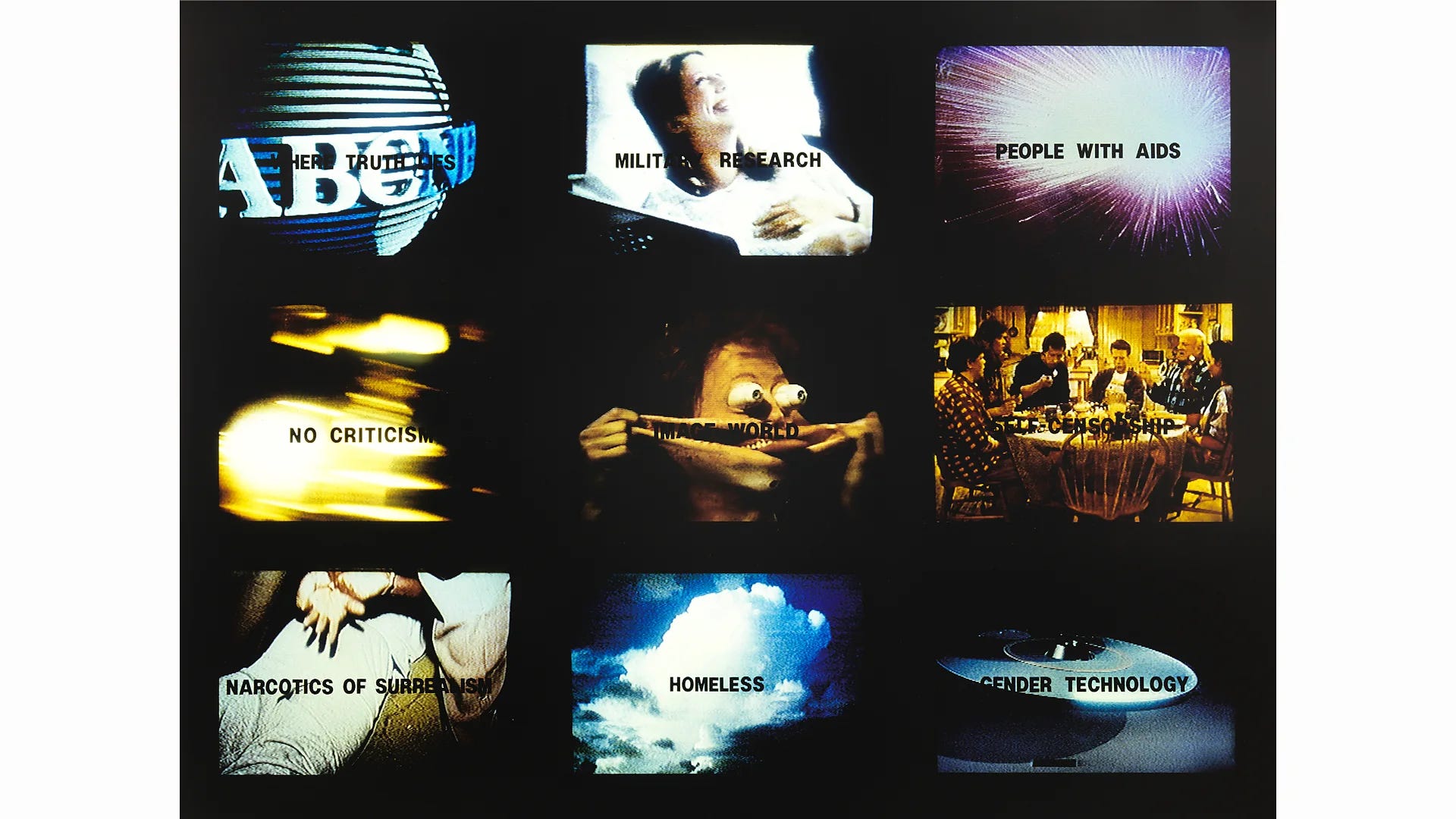
Everything became more available and less distinct at the same time.
DeLillo described it as an accident. But in the real world it is a strategy. And now the same strategy is handed to every brand as if it were real growth: be everywhere, always on, post daily, fill the feed, buy the reach, never let the frame go quiet for a second. Which is another way of saying, manufacture your own white noise, and believe the your white noise makes a difference to anyone.
I must say though, to some people it does look like presence. It does fill the feed. But familiarity, the thing all that volume is actually buying, does not behave the way brands assume it does in the backend.
Repetition is doing two opposite things at once: the same force that grinds a signal down into static is also the only force that lifts a product into a buying ritual.
But familiarity with nothing at its centre becomes white noise. Familiarity built around something worth returning to compounds into meaning.
It is absurd to assume a person’s past behaviour can predict their taste, yet Netflix is the epitome of erosion by familiarity. The library is effectively infinite, arranged by an algorithm, tuned so that nothing ever asks you to pay attention. You open it, you scroll, you settle on something designed to be forgotten, and you forget it. The reach is enormous and the residue is marginal. If you switch off the subscription, the marketing, the recommendation engine, in the end nothing remains, because nothing was ever accumulating underneath.
It is the purest form of rented presence: maximum volume, no memory.
So, what do you do if you are a brand in 2026 and you want to build REAL presence, a durable brand and true consumer loyatly that doesn’t just transfer into sales once, but into recurring revenue?
You don’t play the same game as everyone else. You don’t give into the cultural white noise. You build your own lane.
Here are a few tactical strategies of how to do just that….
First, let’s look at a company doing the exact opposite of Netflix, and winning because of it. Criterion — the film label Fast Company called streaming’s anti-Netflix — has no recommendation engine. Every title is chosen by a human being. The collection is finite, curated, physical, and it costs more. It asks you to choose. And it has built one of the lowest-churn, most loyal audiences in streaming at $10.99 a month, alongside a genuine cultural event in the Criterion Closet, where people queue for hours at festivals to step inside a replica van of shelves. In an era when your other subscriptions quietly delete the films you thought you owned, they are paying, again, to hold the ones they love in their hands. Criterion does not win because it is small or tasteful. It wins, among other reasons, because it owns one idea completely.
Here is how you do the same.
Build an archive, not a feed. Every post that resets your visibility and relevance to zero the moment you stop posting is rented. Every piece that makes the last piece more valuable is owned. Build work that accumulates — a body, a canon, a collection someone can return to and go deeper into — instead of a scroll that buries what you made last. The question before you publish is no longer whether it will perform. It is whether it will still be worth consuming in two years.
Own one idea completely. Criterion refuses breadth on purpose. It would rather own world cinema entirely than rank on everything. Pick the single conviction you would defend even when it costs you, and make every product, hire, collaboration and post point linked to it. Brands that stand for one thing get copied and borrowed from. Brands that stand for everything get scrolled past and forgotten.
Turn attention into a ritual. Recurring revenue is earned only by giving people a reason to come back to something — a cadence they set their week by, a format they half-own, a room they want to be in, physical or not, a product they never want to be out of. One-off reach is a spike. A ritual is a compounding asset over time.
Charge for the IP. Free and infinite is how you become wallpaper. Criterion charges for the choice, and the small act of choosing is exactly what turns a passive viewer into a loyal one. Put your strongest work behind a decision — a price, a membership, a commitment, a product. What people choose, they value. What is handed to them free in the feed, they forget.
In a world of cultural white noise, you can be one more voice in the static. Or you can be a pink flamingo. It is entirely your choice.
Hello Oana,
Thank you so much for sharing this piece and your thoughts. I found it very insightful, and it made me reflect on the way I consume “noise” nowadays.
Lately, I constantly feel either overwhelmed or fatigued — someone could also call it a kind of numbness — particularly when I’m in the digital world. I’ve been trying to pivot towards off-digital/print media (magazines, books, etc.), but it’s hard to completely escape social media.
I think — and hope — that brands can make good use of this current momentum and start producing more wisely, more selectively and more… well, “less.”
Wishing you a great September ahead, and thank you again for sharing!
Konstantinos
Hi Oana, thank you for writing another great piece with some valuable actions to take. The advice to "Build an archive, not a feed" sounds a lot like what Disney does, where their films made decades ago compound in value. I'm going to keep these tactics in my mind for my own newsletter and business, purely because I would do anything to avoid the conventional tactics of being online all the time.